A Sketch Night That Leaves Room to Breathe
Plan a sketch night that leaves room to breathe with flexible scene clusters, simple transitions, and clear cues performers can follow when plans change.
The common mistake when planning a sketch night is treating the running order as unchangeable: a missing prop or a scene that runs long can leave the host scrambling and the next performers unsure what to do. A flexible plan costs less attention than a rigid script for the whole evening. Decide what kind of gathering you are hosting, then give the cast clear options for adjusting the sequence.
Choose the kind of evening you are hosting
Decide whether guests are coming to watch a short show, join a casual workshop, or enjoy a party with occasional performances. Those formats call for different scene lengths and participation. A show can pause between clusters; a party benefits from self-contained scenes that do not require guests to track a continuing plot.
Write one sentence describing the event, such as, “Guests will watch short scenes, with time to talk between clusters.” Use it to assess each idea. If an activity needs a long explanation or requires everyone to move elsewhere, save it for a different gathering.
- For an attentive show: Check whether each scene can be followed on its own; if it depends on earlier material, place it in a clearly introduced sequence, otherwise keep it as a flexible option.
- For a mixed party: Check whether a scene makes sense without a prior introduction; if not, add a brief setup or choose a self-contained piece instead.
- For a workshop-style night: Check whether participation is necessary; if it is, explain the activity before guests arrive, otherwise make joining optional.
Build a running order that can bend
Group scenes by the attention they ask for rather than by topic alone. A wordy exchange followed by another dense scene may feel like one long conversation. A physical bit can change the pace, while a warm character scene may offer a softer contrast after sharper absurdity.
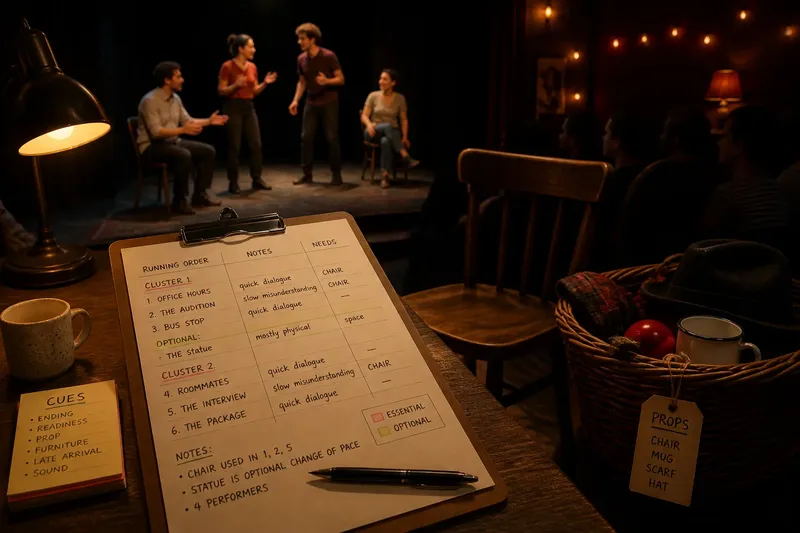
Make a small menu instead of a minute-by-minute schedule. Beside each sketch, write a plain note such as “quick dialogue,” “slow misunderstanding,” “mostly physical,” or “needs a chair.” Mark which pieces are optional and which need a particular performer or prop. The host can then choose what fits next without pretending to predict every transition.
Say you have four performers, three short dialogue sketches, one physical bit, and a chair used in two scenes. Put the dialogue sketches in two clusters, mark the physical bit as an optional change of pace, and reserve the chair for the scenes that need it. If one performer needs a pause, the host can use the optional piece without breaking a scene’s plot or searching for another prop.
Give performers clear cues and simple transitions
A transition gives performers time to reset and tells guests what is happening next. The host can introduce the next scene, move a chair, or offer a brief link between pieces. Keep the link short so it supports the sketches rather than becoming another act.
Agree on a few cues before guests arrive:
- Scene ending: Check that the cast knows the closing gesture or line; if everyone recognizes it, the host can move on, otherwise agree on one cue before the show.
- Performer readiness: Check whether the next cast members are in place; if they are ready, introduce the scene, otherwise use a planned optional piece or a short pause.
- Missing prop: Check whether the scene depends on the prop to make sense; if it does, substitute an agreed object or skip the scene, otherwise let the performers continue without it.
- Furniture change: Check whether the next scene needs a chair or table; if it does, assign someone to move it during the transition, otherwise leave the playing area clear.
- Late arrival: Check whether the next scene relies on earlier plot information; if it does, give a concise setup or choose another piece, otherwise continue as planned.
- Sound cue: Check whether a recording is essential and ready; if it is, assign someone to start it, otherwise use a spoken cue or choose a scene that needs no playback.
Use ordinary objects only when their meaning is easy to establish. A chair can become a bus seat, office desk, or throne if the performers make the choice clear. Keep props together in a labeled basket, and avoid building the evening around a complicated set change.
Choose scenes for your cast and event format
Match the material to the people performing it. Newcomers may prefer a familiar format with a clear premise over a sequence of elaborate characters and costume changes. If the cast has limited energy for hosting and scene changes, share those duties rather than assigning every task to one person.
Check whether guests need to participate, whether a scene needs a specific object, and whether the cast can perform it without a long reset. If any answer points to a bottleneck, simplify the scene, move it earlier, or keep it optional.
Which arrangement fits your gathering?
What works when guests arrive at different times?
Choose self-contained sketches and let the host give late arrivals a brief welcome. If a scene needs earlier plot information, introduce that information in a sentence or choose a different piece.
How can the cast avoid confusion when a scene is skipped?
Mark optional scenes on the shared running order and agree that the host can move to the next listed piece. If another scene depends on the skipped one, keep those pieces together or select an independent replacement.
What should the host do when a prop is missing?
Check whether the prop is essential to the premise. If it is, use an agreed substitute or skip the scene; if it is not, let the cast establish the scene without it.
How can performers share hosting and reset duties?
Assign one person to introduce scenes and another to manage props or furniture when the cast can support both roles. If the group is small, simplify transitions so the host is not speaking while trying to reset the whole stage.
Keep the host’s choices easy to see
Put the running order, prop notes, and optional scenes on one sheet. The host can glance at it between pieces and choose a next action: continue with the planned scene, use the optional replacement, or pause while performers reset. Clear choices make adaptation feel like part of the plan rather than an apology.
Say you have a cast of three, a printed list with two scene clusters, and a short silent sketch marked optional. One performer needs a break after the first cluster, so the host checks the sheet, introduces the silent sketch, and uses its ending to give the performer time to return. The observable result is a changed sequence with no missing plot information and a clear cue for the next scene.
Choose an ending that fits the cast’s energy and the gathering’s format. A short final scene followed by a clear sign-off can close the event cleanly; if performers are ready to stop before the last planned piece, the host can thank guests and end without forcing an extra scene.
Share the plan with performers before guests arrive, including the welcome, scene clusters, optional pieces, and cues for moving on. If a sketch uses a song, recording, or borrowed material, follow the relevant rights holder’s instructions and applicable local rules. For a sketch night that leaves room to breathe, the useful final check is simple: every scene has a place, every essential prop has a plan, and the host knows what to do when the order changes.