From Monologue to Microphone: How Comic Address Changed Across Media
From monologue to microphone, trace how theater, radio, television, and stand-up shaped comic address—and learn what each format asks of a performer.
The most common mistake in tracing the comic monologue is treating the microphone as the moment it became a conversation. The cost is a flattened history: solo comic address existed before amplification, while radio, television, and stand-up each gave it different audiences and conventions. From monologue to microphone, the story is less a straight evolution than a series of changes in who could hear the performer and how the address was framed.
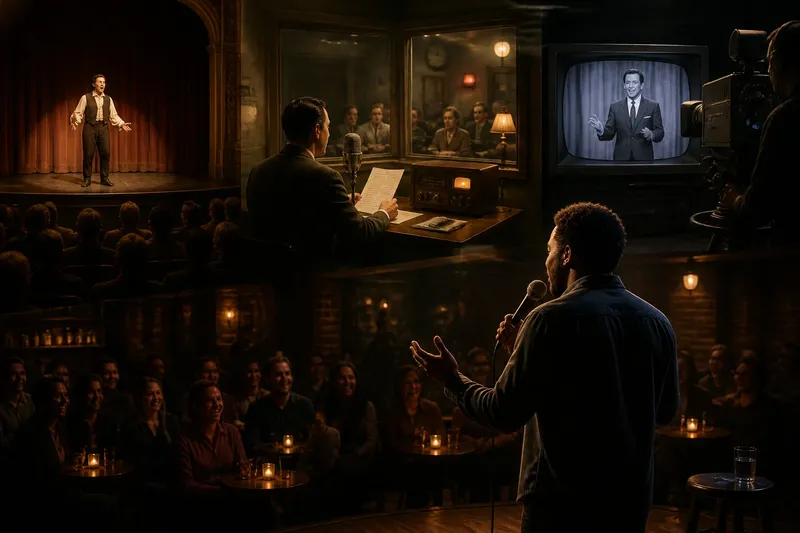
Theater made solo comic address a public turn
A monologue describes one speaker holding the floor for an extended passage. It does not name a single venue or style. A comic may speak directly as themself, adopt a character, or string together observations in a voice that seems continuous.
In theater, the proscenium stage and curtain made the performer’s turn visibly distinct from the audience’s seats. The arrangement did not dictate a formal tone: a comic could sound confiding while standing apart from listeners. But the stage established a public frame, and the audience received the address together.
That shared setting gave the performer control over sequence and transitions. The comic decided when a thought ended and another began. Audience response could shape the moment’s pace, but listeners generally did not take over the structure of the speech.
Theater also offered a durable tension: the performer spoke to a crowd while making the address feel personal. A comic could present a private embarrassment as a story for everyone in the room. The audience’s presence made the confession public; the chosen voice could still make it sound intimate.
Radio carried the comic voice beyond the theater
Radio changed the reach of comic address without requiring a visible stage. A microphone transmitted the performance to listeners outside the venue, and the audience at home could not see gestures, costumes, or the room’s reactions. The voice had to carry the scene and establish the speaker’s relationship with listeners.
This did not make every radio monologue a direct conversation. A performer might speak to a studio audience, to unseen listeners, or to both at once. The broadcast format also placed the address inside a program: an introduction, a speaking turn, and a transition could make a solo comic performance feel composed even when its delivery sounded casual.
The important change was the divided audience. People in the studio shared a room with the performer; listeners elsewhere encountered a voice carried into private spaces. A line directed toward the studio could still reach remote listeners, but those audiences did not share the same physical moment.
Television gave the monologue a visible frame
Television added the camera’s selection of what viewers could see. A host at a desk, a performer facing the lens, or a stage framed by the broadcast all signaled different relationships to the audience. The people watching at home saw some details of the performance, but not necessarily the whole room or every response.
As with radio, a television monologue could address more than one audience at once. A performer might acknowledge people present in the studio, then turn toward the camera for a line meant to reach viewers directly. The camera did not turn the performance into an unmediated chat; it gave the address another point of contact and another set of conventions.
These media did not replace theater. They made solo comic address portable and adaptable: a performance could be shaped for the room, the receiver, the camera, or a mixture of all three. The form remained recognizable while its audience and presentation changed.
Stand-up made the microphone part of the live encounter
Stand-up and monologue overlap, but they are not interchangeable terms. Stand-up names a performance format commonly built around a comic addressing an audience. Monologue describes an extended address by one speaker and can appear in theater, television, or other formats as well.
In stand-up, the microphone is both sound equipment and a visible marker of the performer’s turn. It can make a low-volume delivery audible, while its presence reminds the room that one person is presenting prepared material. A hand-held microphone can accompany movement; a stand can keep the speaker in a stable position. Neither choice has a fixed meaning apart from the performance and its setting.
Live response can affect timing without making the audience a co-author of the routine. A laugh may delay the next line; silence may change how a pause feels. The performer still shapes the sequence, and the microphone helps carry that sequence through the room.
The contrast with broadcast is not simply closeness versus distance. A club audience may be physically near the performer, while a television viewer may feel directly addressed by a camera-facing line. Each format creates its own sense of access, shaped by where the performer directs attention and how the audience receives the performance.
What changed from monologue to microphone?
Did the microphone create stand-up comedy?
No. The microphone amplified and marked a speaking turn, but solo comic address predates it. Stand-up developed as a performance format with conventions that cannot be reduced to the equipment used to carry sound.
How did radio change a comic monologue?
Radio carried a performer’s voice beyond the venue and removed visual information for remote listeners. Comics and program makers had to rely on spoken details and vocal delivery to make the address legible without a visible stage.
What did television add to comic address?
Television let a camera frame the performer and select what viewers saw. A comic could address the studio audience, the camera, or both, while the broadcast format shaped how the performance reached people at home.
Is a stand-up set always a monologue?
A stand-up set often consists of an extended address by one comic, so the forms can overlap. But “monologue” describes a mode of speaking, while “stand-up” describes a performance format with its own conventions.
Compare formats by following one premise
Say a comic is working with an invented premise: at a crowded gathering, everyone waits for someone else to claim the only empty chair. The comic wants the audience to understand both the awkward pause and the competing signals. The premise stays fixed, but the delivery must supply whatever the format leaves unseen.
- Theater: If the imagined staging includes visible actors and a chair, then let the physical pause carry part of the joke; if the audience would not see the chair clearly, then add a spoken detail that identifies it.
- Radio: If listeners cannot see who is hovering by the chair, then describe the silence or a small sound that signals hesitation; if the spoken scene becomes hard to follow, then reduce the number of people in it.
- Television: If the camera can show the chair and the waiting group, then keep the explanation brief; if the framing hides a reaction the joke depends on, then add a line that makes the missing information audible.
- Stand-up in a club: If the comic is addressing a live room with a microphone, then make the awkwardness clear in the wording before pausing; if the pause obscures the premise, then state what the crowd is waiting for.
- Camera-facing delivery: If the comic aims the line at viewers at home, then use a direct address that makes the situation easy to follow; if that address feels too formal for the intended tone, then speak to the scene rather than naming the viewer.
- Stand-mounted microphone: If the comic wants a fixed speaking position, then keep the action in the story rather than relying on movement; if the premise needs a visible physical contrast, then choose a small gesture that remains clear from the audience’s seats.
For this invented situation, the answer is to keep the central conflict—the group’s reluctance to take the chair—and change only the information each format can supply. Theater can show the chair, radio must describe the silence, television can frame the waiting faces, and stand-up can build the scene with words and timing. That comparison reveals how the comic address changes without claiming that one medium invented the premise or the form.
From monologue to microphone, the useful historical distinction is not that public speech became private conversation. Theater, radio, television, and stand-up placed the comic voice in different relationships with gathered and remote audiences. When you encounter a performance, notice who can see the speaker, who can hear the room, and where the address seems aimed; those details explain the form’s changing sense of intimacy better than the microphone alone.